App Store Optimization, on your Mac
Claude Code ASO: turn store evidence into a focused audit
Claude Code ASO works best when you give the agent a specific market question and ask it to show the evidence behind its answer. Start with one country, a clear product brief and the current listing, then move from research to a small set of changes you can review.
See AppNorth for Mac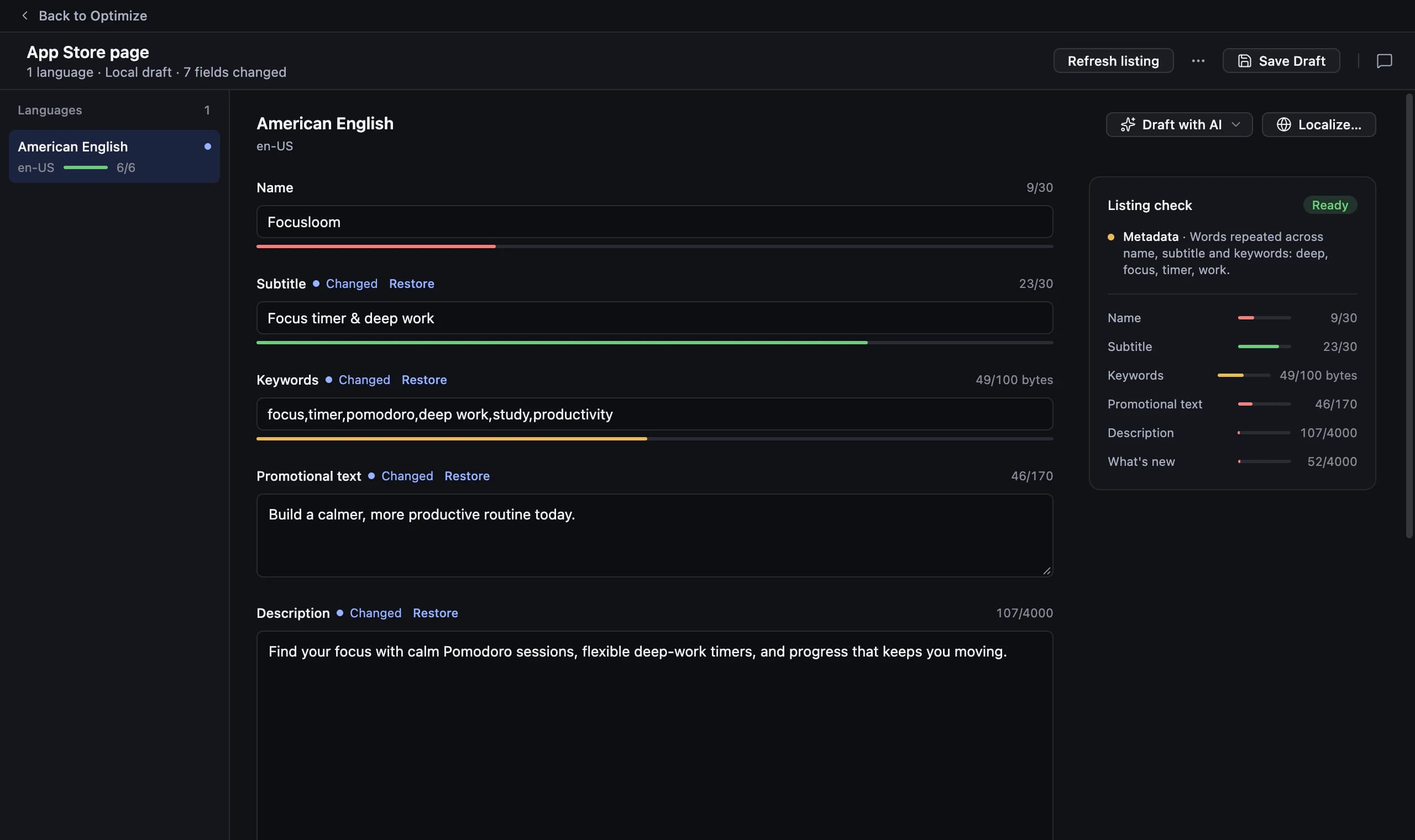
Give Claude Code ASO a question it can answer
An ASO audit should answer a decision, such as whether your subtitle describes the searches you want to reach. Asking for “better ASO” leaves the agent to choose the market, audience and success criteria itself. Specify the platform, country, language and user problem before asking it to judge keywords or rewrite a field.
App Store optimization with Claude Code becomes more useful when product context meets store evidence. AppNorth provides keyword research, country rankings and competitor comparisons through a local MCP server with 127 tools. Use that connection to test a hypothesis rather than treating the agent’s familiarity with your code as knowledge of what people search.
Connect Claude Code from AppNorth
Install Claude Code on the Mac you will use for the audit. In AppNorth, use the one-click “Add to Claude Code” action for the installed agent. AppNorth starts itself when the agent needs it. Begin with a request to inspect the selected app and country so you can check the context before asking for recommendations.
Prepare the workspace before the first request: add your published app by link or search, or research an idea without an app. Write a product brief and a “Don’t target” list. For example, a habit timer that has no team features should exclude team scheduling searches, even if those phrases initially look attractive.
Ask for an evidence-led country audit
For a made-up app called QuietSprout, try this prompt: “Audit QuietSprout for the US App Store. It is a solo habit timer, not a team planner. Inspect the current listing, tracked keywords and competing apps. Separate observed data from assumptions, identify missing inputs and recommend three changes. Do not publish anything.” The example names a decision boundary as well as a research task.
For an ASO audit, Claude Code should explain more than a score. AppNorth’s audit gives a 0–100 score per country from rankings, listing and competition, with a few priority fixes. The full score needs Apple Ads popularity. Ask the agent to explain the proposed fixes and the available evidence, not simply repeat the number.
Challenge keyword ideas before using them
Follow up with: “Compare ‘habit timer’ and ‘daily routine’ for this product and country. Explain which ranked apps serve the same need and which results suggest a different intent. Identify what the available data cannot establish.” These phrases are illustrative examples, not measured recommendations. A broad phrase may describe a larger category while giving a narrower app a poor fit.
AppNorth shows Apple’s official Apple Ads popularity only when you connect your own Apple Ads account; otherwise the value is “—”. Ask the agent to preserve that missing value instead of inventing search volume. Its difficulty indicator reflects apps already ranking for a search. Use it alongside relevance and competitor context, as a signal rather than a ranking promise.
Turn findings into a listing you can review
Once the evidence supports a direction, ask: “Prepare alternatives for the name, subtitle and keyword field. Explain what each changes from the current listing, keep only supported features and stay within the field limits. Stop at drafts.” AppNorth’s step-by-step optimization offers three AI drafts, scored by reach and difficulty against the current listing, within Apple’s character limits.
Review the wording as a user would read it. A subtitle must communicate a reason to try the app as well as accommodate relevant language. AppNorth lets you review and preview changes before publishing. For App Store Connect, publishing fills a draft version with approved changes; it never submits the app for review. Keep that distinction explicit in your request.
Return to the audit after a deliberate change
Record the old fields, the replacement text, the country and the reason for the change in your working notes. Ask Claude Code to summarize the hypothesis in one sentence so that a later review has a clear question. Avoid changing the audience, country and all metadata at once if you want to understand which decision deserves another look.
AppNorth tracks iPhone positions up to 250 per keyword and country, with daily history and a configurable check frequency for each app. Use that history for a follow-up prompt: “Review the tracked searches associated with our subtitle hypothesis and describe what changed.” A position change is an observation; it does not by itself prove that your metadata edit caused it.
Before you start
Can Claude Code do ASO before my app is published?
Yes. AppNorth supports keyword research without an app, so Claude Code can help investigate an idea before launch. Give it a product brief, a country and explicit exclusions. Focus the task on search intent and competing results; without your own published listing, it should not describe hypothetical app rankings as measured performance.
Do I need an Apple Ads account for Claude Code ASO?
You need your own connected Apple Ads account to see official popularity in AppNorth and obtain the full audit score. Without it, popularity displays “—”; the agent should treat that as missing data. Apple Ads onboarding is free and needs no campaign or card, so connecting it does not require starting an advertising campaign.
Does AppNorth include Claude Code credits?
No. AppNorth’s AI features run through your own CLI, and your chosen provider’s terms and costs apply. AppNorth costs €99.99 once for a lifetime license covering two Macs, with updates included. There is no free tier or trial. Treat the AppNorth license and your agent provider’s usage as separate purchasing decisions.
Can Claude Code work on Google Play ASO too?
AppNorth also supports Google Play keyword research, positions, competitor comparisons, listing editing and publishing, plus localized prices. It needs a Google Play service account. Start a separate Android task with its own country and product context; do not copy an iOS keyword-field plan into it. Google Play publishing goes through Google’s own review.
Keep exploring
AppNorth · macOS
Turn your research into a better listing.
€99.99 once. Lifetime license for 2 Macs, with updates included.
AI features use your own agent CLI: Claude Code, Codex, Gemini CLI, OpenCode, Cursor, Grok or Ollama. No AppNorth AI credits; your provider’s terms and costs still apply.
See AppNorth for MacmacOS only. No free tier or trial. No voluntary refunds; legal exceptions apply. Read the refund policy.