App Store Optimization, on your Mac
Validate an app idea before committing to the full build
To validate an app idea, investigate the problem, the alternatives, and the people who might change their habits to use it. Store research helps you discover search language and competing promises; conversations and a small prototype help you test whether the proposed solution deserves more development time.
See AppNorth for Mac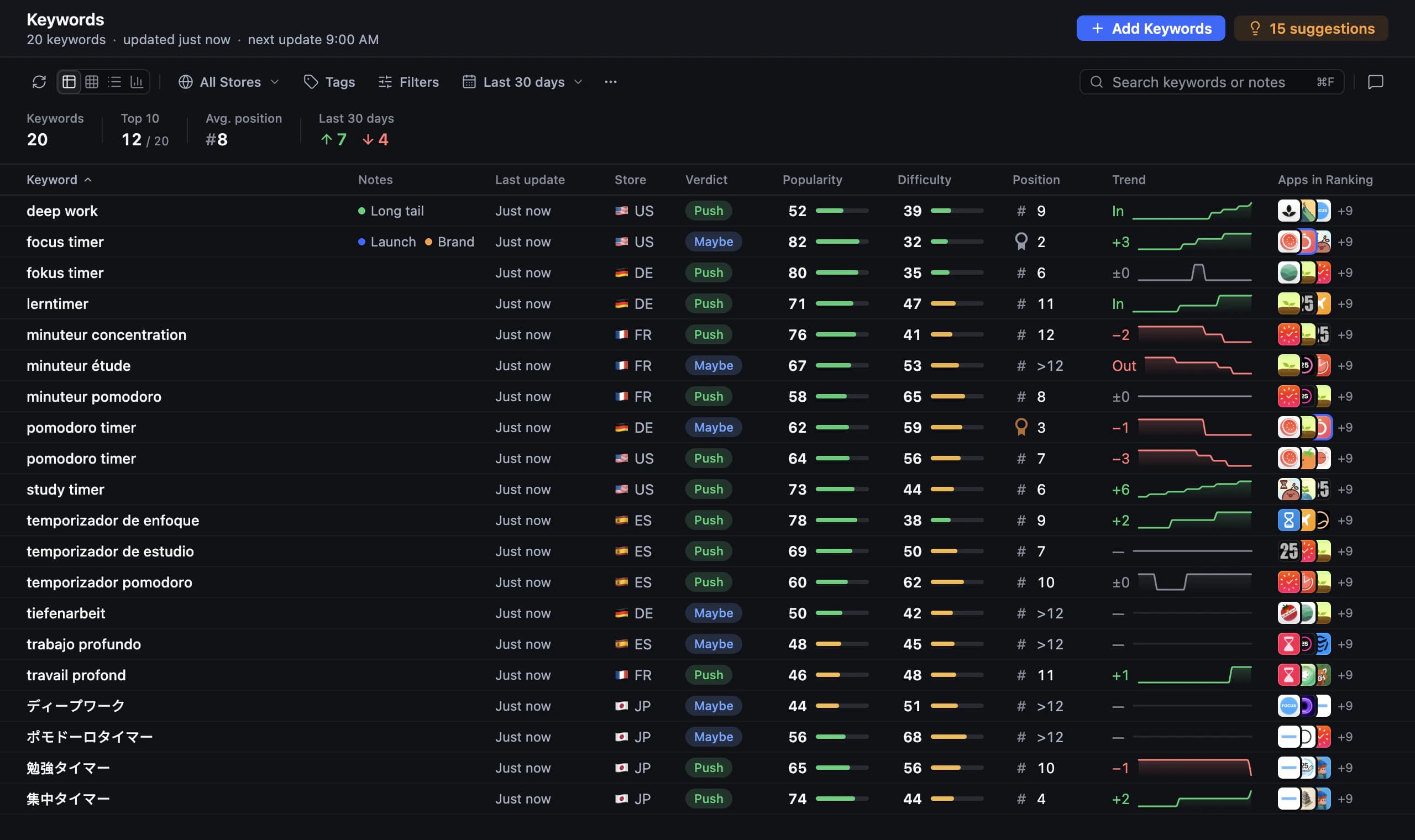
Validate an app idea by defining the risky assumption
Write down who has the problem, when it occurs, and what they do today. Then identify the assumption that would make the project fail if it proved false. Perhaps the task happens too rarely, the current workaround is good enough, or users would not trust an app with the information involved. Test that uncertainty before planning a long feature list.
Consider ShiftPantry, a made-up app for nurses planning meals around changing shifts. Its starting hypothesis is not simply that people want meal plans. It is that rotating schedules make ordinary weekly plans difficult to maintain. That distinction changes the questions you ask, the competitors you inspect, and the smallest prototype worth building. An attractive generic meal planner would not test the specific hypothesis.
Use app market research to map search intent
Choose a first country whose language and support needs you can handle. Write candidate searches around the task, the audience, and the current workaround. Inspect both broad and specific phrases, noting whether results serve the same need. Keep App Store observations separate from Google Play observations. A familiar phrase can produce a different set of alternatives in another store or country.
For the fictional ShiftPantry example, compare “meal planner,” “shift worker meals,” and “meal prep calendar” as research candidates, not proven opportunities. Relevant results suggest existing ways to describe the problem. Sparse results might mean unfamiliar wording rather than unmet demand. Likewise, a popularity indicator concerns a search term; it does not establish how many people will want your particular solution or pay for it.
- Task terms: what someone wants to get done.
- Audience terms: who faces the situation you are studying.
- Workaround terms: tools or routines people already use.
- Excluded terms: needs your first version will not address.
Compare alternatives without mistaking a gap for demand
Review the public promise, screenshots, visible offer, and reviews of relevant apps. Add non-app alternatives to your notes: a spreadsheet, calendar, or shared message thread may be the real substitute. Ask what each option makes easy and what it asks users to tolerate. An app idea can face strong competition from a simple habit even when no listing describes the exact feature you imagined.
Look for a specific friction your proposed workflow could remove. In ShiftPantry’s case, manually moving meals when a shift changes is a hypothesis to investigate. A review requesting calendar flexibility can help you frame a question, but it is not proof that nurses share that need. Avoid building from a collection of feature requests without checking whose situation each request describes.
Test the problem and the smallest useful workflow
Talk to people who face the situation and ask about their most recent experience. Have them describe what happened, show the workaround if they are comfortable, and explain what they tried before. “Would you use this?” invites an easy answer. Questions about actual behavior give you more concrete evidence for deciding whether your proposed workflow solves a problem that matters.
Show a small prototype that tests the risky assumption, then ask the person to complete a realistic task. For ShiftPantry, that might mean moving a planned meal after a shift change. Decide in advance what would make you continue, narrow the audience, or stop: repeated examples of the problem, an understandable workflow, and willingness to try it again. Treat stated willingness to pay as a hypothesis needing further evidence.
Build a pre-launch ASO research plan in AppNorth
AppNorth is a Mac app that supports keyword research without a published app, including App Store research in all 175 App Store countries and Google Play keyword research. Use it to investigate candidate phrases before building. Its product brief and “Don’t target” list keep AI suggestions focused on the product. Research notes should still distinguish a useful phrase from evidence that the underlying business will work.
App Store popularity uses Apple’s official Apple Ads popularity when you connect your own Apple Ads account; otherwise AppNorth shows “—”. Apple Ads onboarding needs no campaign or card. AppNorth’s difficulty indicator is based on apps already ranking and is a signal, not a promise. Once an app is published, you can add it by link or search and use live observations to revisit your launch assumptions.
Before you start
How can I validate an app idea without coding?
Write a specific problem hypothesis, inspect current alternatives, and interview people who recently faced that situation. Use a sketch or clickable prototype to test one realistic task. Store keyword research can help you choose language and identify search rivals. Together these activities can expose a weak assumption before coding, although they cannot guarantee demand for the finished product.
Does a popular app keyword prove demand for my idea?
No. A popularity signal can inform your research into a search term, but it does not show that users want your exact workflow, will switch from another solution, or will pay. Inspect the results to understand the intent behind the phrase. Then test the problem and proposed experience with people from your intended audience before treating the term as a business opportunity.
Should I abandon an app idea if competitors already exist?
Existing apps give you alternatives to study, rather than an automatic reason to stop. Check whether your intended users are well served and whether your approach removes a specific friction. The absence of direct rivals also deserves investigation: people may use another kind of tool, describe the problem differently, or have little reason to change their current behavior.
What should I prepare for pre-launch ASO?
Prepare a first-country choice, a clear audience and task, a shortlist of relevant searches, and a listing promise your prototype can support. Note the competing results and the assumptions still untested. AppNorth lets you research keywords without an app. Keep the plan provisional, then revisit it with actual listing and rank observations once your product is published.
Keep exploring
AppNorth · macOS
Turn your research into a better listing.
€99.99 once. Lifetime license for 2 Macs, with updates included.
AI features use your own agent CLI: Claude Code, Codex, Gemini CLI, OpenCode, Cursor, Grok or Ollama. No AppNorth AI credits; your provider’s terms and costs still apply.
See AppNorth for MacmacOS only. No free tier or trial. No voluntary refunds; legal exceptions apply. Read the refund policy.